
The latest on the farm
Take a look at the field two weeks after spreading our 2025 biochar farmyard amended manure
Incredible Results from Biochar-Amended Farmyard Manure
At Carbon Hill, we’re seeing remarkable improvements in field performance after applying farmyard manure amended with biochar. Just two weeks after spreading, the newly planted herbal ley shows stronger establishment, faster growth, and healthier soil structure.
Sixteen days after applying biochar-amended farmyard manure for the 2025/2026 season, the results across the newly planted herbal ley have been extremely positive. Following a period of drought and recent rainfall, grass growth has recovered rapidly, with strong establishment and visibly improved soil condition.
Soil inspection has shown a well-aggregated structure with good root depth and active organic matter throughout the plough layer. Early Brix readings taken indicate healthy nutrient levels (around 6–7), suggesting good photosynthetic activity and nutrient transfer.
This application used manure composted with biochar for only four to five weeks before spreading. Despite the short composting period, the material has provided a noticeable improvement in soil recovery, nutrient retention, and plant performance.
The results highlight the continuing benefits of integrating biochar into regular nutrient management and rotational grazing systems, supporting healthier soils and more resilient pastures across the farm.
For a closer look at the field and Mick’s detailed observations, watch his follow-up video here.
Spreading Biochar-Amended Farmyard Manure
Out in the fields this season, we’ve been applying our 2025 biochar-amended farmyard manure. This latest application builds on several years of practical work with biochar and manure, and it’s helping us understand how the material performs under real farming conditions rather than controlled trials.
The manure used in this application was produced through a partnership with a local feedlot, where biochar fines were added directly alongside the barrier to capture both urine and manure before composting. After only a few weeks of breakdown, the result was a well-balanced mix that handled easily through the spreader and produced no smell, an indicator that ammonia emissions were significantly reduced. This kind of reduction in nitrogen loss not only helps improve nutrient efficiency but also supports a lower-emission approach to manure management.
Mick Jones, The Biochar Farmer, noted how this method seems to retain more available nitrogen and improve overall soil performance. Over time, repeated use of biochar-amended manure has shown clear signs of improving soil structure and boosting phosphate availability. Soil testing has confirmed these observations, with phosphate levels now reaching optimal ranges after several years of application. The manure also appears to decompose faster once spread, breaking down cleanly and leaving an even coverage across the field.
Beyond nutrient data, there are visible benefits too, such as stronger early grass growth and improved moisture retention. These signs suggest that biochar’s porous structure is supporting microbial activity and creating conditions for better long-term soil health.
Each spreading season continues to add new insight into how biochar behaves and how it can be adapted within a working farm system. It’s not about replacing existing methods, but about enhancing what’s already there making every tonne of manure go further and work smarter.
For a closer look at the field and Mick’s detailed observations, watch his follow-up video here.
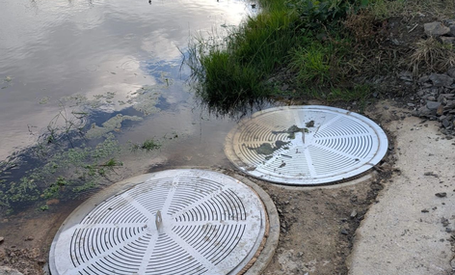

River guard system
Farm-developed biochar filtration designed to keep nutrients on the land
At Carbon Hill, we’ve been developing practical, solutions to support cleaner water and better nutrient management. The latest addition to that effort is the River Guard, a simple biochar filtration system built and tested on the farm to help reduce nutrient and sediment runoff before it reaches waterways.
The concept behind River Guard is straightforward: modular filter units that capture phosphorus, nitrates, silts, and dust. This work has particular relevance in catchments such as the Wye and Severn, where research indicates that around three-quarters of phosphorus entering rivers originates from agricultural land. That excess nutrient load drives algal blooms and smothers river gravels. Each River Guard unit is built for reality rather than demonstration, it is durable, practical, and easy to service using standard farm equipment. The system’s design means filters can be swapped or maintained as part of normal yard routines, helping integrate water quality management into everyday operations without added complexity.
The project builds from on-farm experimentation with biochar filtration by Mick Jones and the Carbon Hill team. By using biochar produced at Woodtek, the system has also allowed real-world testing of biochar’s potential to capture pollutants, from nutrients to fine particles.
While still being rolled out on a limited basis, River Guard demonstrates how practical, farm-developed innovation can make an immediate difference to both soil and water health.